Setting the Scene: The Real-World Reality of Legacy Software
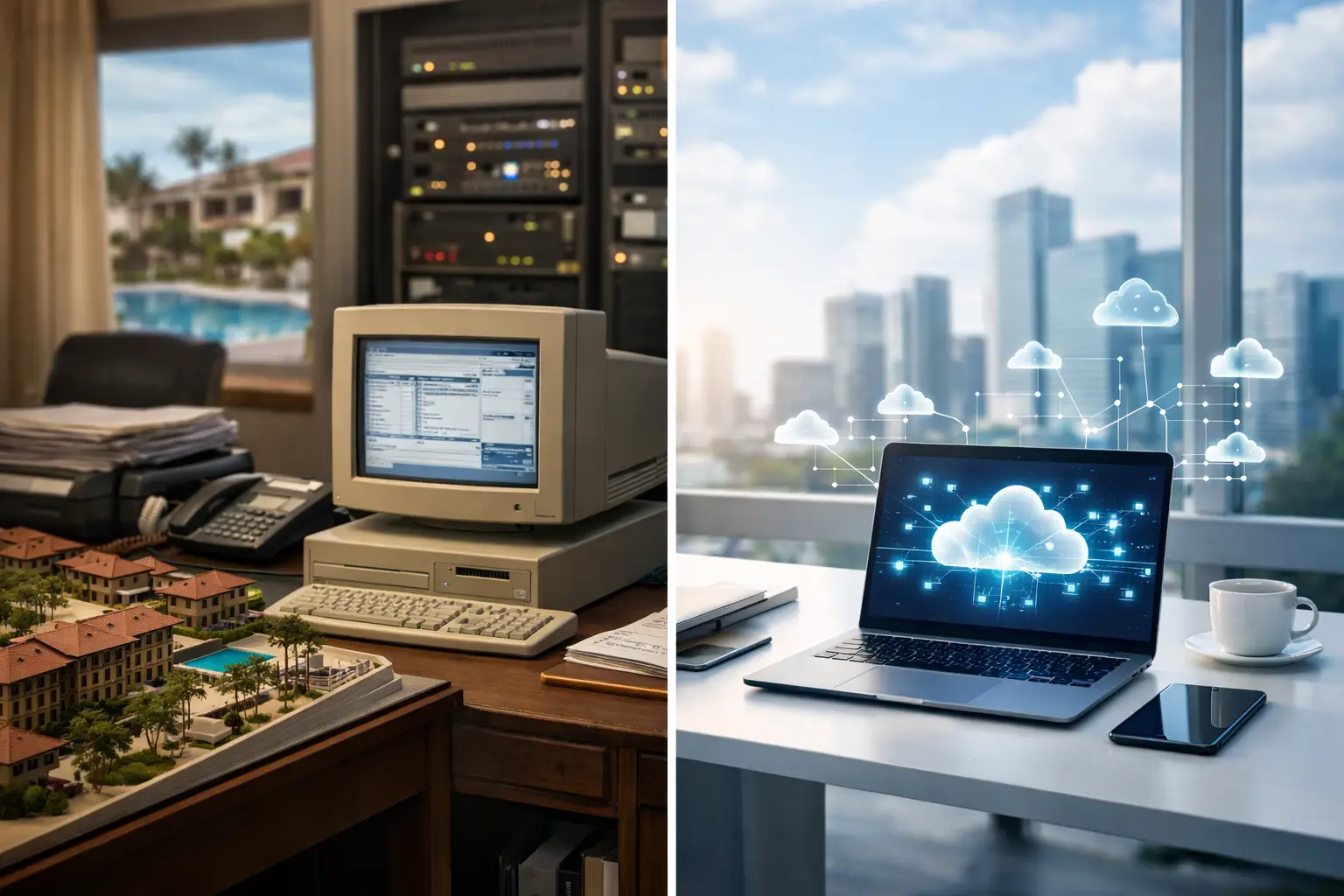
Imagine a typical peak arrival day at a busy vacation club or HOA property. The front desk team is struggling with local server lags, member services is taking heated calls from owners whose online fee payments haven’t synced, housekeeping is working off printed paper lists that were outdated two hours ago, and the finance department is bracing for a month-end nightmare of manual spreadsheet reconciliations.
When a resort relies on legacy, on-premises software or a patchwork of disconnected applications, this level of operational friction becomes daily routine. In the vacation ownership and fractional industry, software is not just an administrative tool—it is the operational central nervous system of your property.
What You Will Discover in This Article
This comprehensive guide breaks down the structural differences between legacy resort systems and modern cloud-native platforms, helping operators evaluate their long-term technology strategy.
Here is a quick summary of what you are about to read:
-
The Hidden Costs of Legacy Friction: How fragmented software creates departmental data silos, delays financial reporting, and inflates administrative overhead.
-
How Cloud Platforms Transform Operations: The structural mechanics of running front desk, housekeeping, accounting, and owner services off a single, centralized database.
-
Direct Side-by-Side Comparison: A breakdown comparing legacy systems against cloud platform capabilities across reporting, workflows, and owner service.
-
Practical Operational Gains: Where cloud migration delivers immediate ROI—from real-time housekeeping routing to dynamic owner portals.
-
Transition & Evaluation Framework: How to manage a phased software migration, clean historical ownership data, and test new tools against real resort scenarios.
Legacy Resort Systems vs. Cloud Platforms: Evaluating the Operating Model
Legacy resort systems vs cloud platforms is not simply an IT decision. It determines whether reservations, owner balances, maintenance tasks, sales activity, and financial reporting operate from the same current information or require staff to reconcile separate systems.
For resorts, vacation clubs, and HOAs, cloud software is usually the stronger long-term operating model because it centralizes data and workflows across departments. But a successful move depends on more than replacing an old server. It requires a platform built for the way vacation ownership businesses handle inventory, recurring fees, contracts, owner service, and multiple entities.
Why do legacy resort systems create operational friction?
A legacy system may still process reservations or post charges correctly. The problem is often everything around those core transactions. When a front desk team, finance department, sales office, and owner services team rely on separate applications, spreadsheets, exports, or manual workarounds, the operation loses its single source of truth.
Consider a common owner call: an owner wants to confirm a reservation, review a maintenance fee balance, rent unused time, and ask about a transfer. In a fragmented environment, the agent may have to open separate screens, wait for a batch update, email accounting, or promise a callback. None of those steps improves service, and each creates room for a missed detail.
Legacy on-premises systems also tend to make change expensive. A new report, integration, user workflow, or portal feature can require local IT involvement, server maintenance, scheduled upgrades, and testing across custom configurations. That can leave operators postponing improvements that staff and owners need now.
The real cost is often outside the software license
The cost of an older platform is not limited to hardware, support contracts, or upgrade projects. It appears in duplicate data entry, delayed month-end processes, manual commission calculations, disconnected guest communications, and the time managers spend validating reports before they can act on them.
For multi-property operators, the issue becomes more pronounced. Different resorts may use different coding structures, reporting methods, and local processes. Finance teams then spend more time consolidating information than analyzing it. A cloud platform with multi-company and multi-currency capabilities can bring those operations into a controlled structure without forcing every property into an identical guest experience.
How does a cloud-based resort platform work?
A cloud-based resort platform runs from centrally managed infrastructure rather than a server at each property. Authorized users access current information through a browser or purpose-built web application, while the platform maintains shared records for reservations, inventory, owners, contracts, accounting, and operational tasks.
The practical benefit is continuity between departments. When a reservation changes, the front desk, housekeeping schedule, owner record, and relevant financial activity can reflect that change in the same operating environment. When finance posts a payment or adjusts an account, owner services does not need to wait for a separate overnight sync to see the updated balance.
This model is especially useful for vacation ownership because the business is not only about a room night. It includes fixed weeks, floating time, points, memberships, owner accounts, maintenance fees, exchanges, rentals, sales contracts, commissions, and HOA reporting. Generic hotel software can manage a stay. It may not provide the business rules and financial depth needed to manage the ownership relationship before and after that stay.
Merlin Software brings these functions together through the Merlin Ecosystem:
-
Merlin CORE for property, contract, and multi-currency financial management.
-
Merlin Web Apps for real-time mobile staff workflows (front desk, housekeeping, maintenance).
-
Merlin Portal for customer self-service (online bookings, maintenance fee payments, statement access).
-
Merlin World for owner engagement and secondary-market rental/exchange activity.
The value is not that each function exists independently. It is that the exact same operational and financial records support them simultaneously.
Legacy resort systems vs cloud platforms: what changes?
The difference is best measured in daily operating control, not in technical terminology.
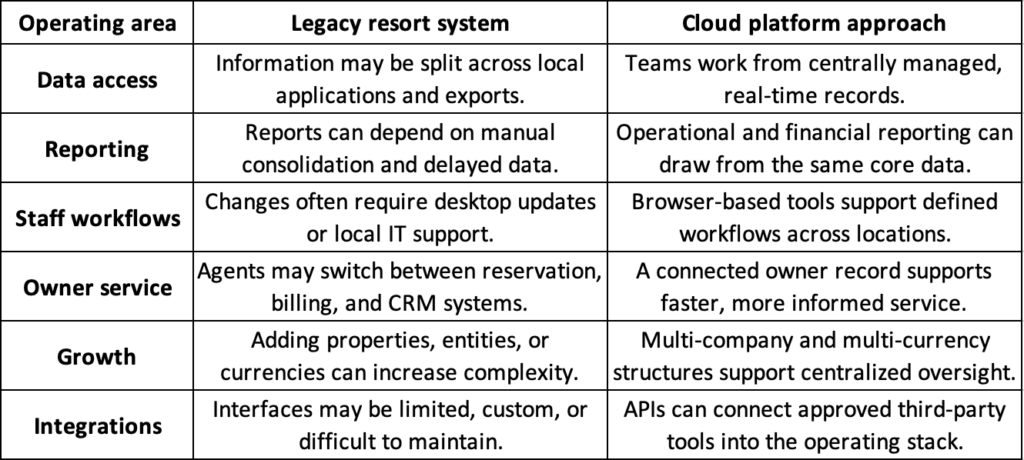
Cloud does not mean every process should be automated without oversight. Resort operators still need approval controls, audit trails, role-based access, and clear ownership of exceptions. The advantage is that these controls can be designed into shared workflows rather than handled through email chains and disconnected spreadsheets.
Where does the cloud deliver the clearest operational gains?
The first gain is visibility. A resort manager should be able to see occupancy, arrivals, housekeeping status, outstanding balances, and relevant owner activity without requesting reports from several departments. Finance should be able to trace transactions through a complete financial hub with the appropriate chart of accounts and VAT handling, rather than rebuilding the story from exports.
The second is service capacity. A customer portal can reduce routine calls by allowing owners and members to view relevant information and manage selected requests themselves. This does not replace owner services. It gives the team more time for exceptions, high-value interactions, and situations that need a knowledgeable person.
The third is revenue coordination. Rentals, resales, exchanges, and auctions are often treated as separate initiatives because the data sits outside the core operation. When inventory, owner relationships, reservations, and financial records are connected, operators can manage these opportunities with clearer controls and less rekeying. That matters when the business wants to expand revenue without expanding administrative headcount at the same rate.
Housekeeping and maintenance also benefit from current operational data. Staff should not be working from a static arrival list while the front desk is processing last-minute changes. Web-based workflows allow teams to see assigned work, update status, and escalate issues in the same operating environment used by the property team.
When might a legacy system remain in place?
There are valid reasons to phase a transition rather than replace everything immediately. A property may have specialized interfaces, historical data requiring careful cleanup, limited internal change capacity, or a peak season that makes a major rollout impractical. The right question is not whether a legacy system has reached a certain age. It is whether it can support the operation’s next five years without creating increasing manual work and risk.
A phased approach can be sensible when the platform supports modular adoption. An operator might first centralize core records and accounting, then introduce staff web apps, owner self-service, or secondary-market tools as processes are standardized. The sequence should follow operational pressure points, not a generic technology checklist.
Data migration deserves particular attention. Ownership history, contracts, balances, inventory rules, and reservation records are business-critical. Before moving, teams should identify duplicate owner records, inactive inventory, inconsistent account codes, and undocumented exceptions. Cleaning these items is work, but carrying them unchanged into a new platform only recreates the old problems in a newer interface.
What should operators evaluate before moving to the cloud?
Start with the full lifecycle of an owner, guest, or member record. Can the platform manage the sale or contract, account setup, reservations, billing, collections, communications, service requests, and future rental or resale activity without creating separate data silos? If the answer is no, the organization may still be buying integration projects instead of gaining integration.
Then test the financial model. Vacation ownership operators need more than a basic general ledger connection. They need reliable controls around recurring charges, owner balances, commissions, collections, multiple companies, currencies, and property-level reporting. Finance should be part of the evaluation from the beginning, not brought in after the operational decision is made.
Finally, ask how the platform behaves under real resort conditions.
A product demonstration should showcase real day-to-day scenarios rather than isolated features, such as:
-
How quickly a front desk agent resolves an owner question.
-
Whether a manager has full visibility across properties.
-
If an HOA board receives clear, meaningful reporting.
-
How staff transition from personal spreadsheets to defined processes.
The best cloud move is one that gives each department better control while preserving a shared view of the business. Start with the workflows that cause the most callbacks, reconciliations, and workarounds, then use that evidence to build a transition plan the operation can actually sustain.
Achieving Operational Unity in the Cloud
Moving from a legacy resort system to a cloud-native platform is not merely a technical server migration—it is a fundamental upgrade to your resort’s business model. By replacing fragmented software silos with a single database architecture, operators remove data drift, eliminate month-end spreadsheet reconciliations, and give staff real-time visibility across front-office, back-office, and member-facing channels. The Merlin Ecosystem delivers this unity through Merlin CORE, Merlin Portal, Merlin Web Apps, and Merlin World, ensuring your entire property runs from a single source of truth.
Next Steps: Schedule a Live Demonstration
Stop managing software gaps and start running your resort with total operational clarity. To explore how Merlin Software can transform your property’s technology infrastructure, visit easymerlin.com or contact Mike Ashton, SVP of Resort Partnerships, to schedule a personalized live platform walkthrough.
-
Email: MikeA@quickmerlin.com
-
Phone: +1 246 230 4982
-
Web: easymerlin.com
Frequently Asked Questions
What is the main operational difference between a legacy system and a cloud platform like Merlin Software?
Legacy systems rely on local servers or separate applications that require batch imports, exports, or spreadsheets to share data. A unified cloud platform like Merlin Software operates on a single, centralized database. When an owner updates their profile, books a week, or makes a payment, the change posts immediately across accounting, housekeeping, front desk, and member services in real time.
Can a resort transition from a legacy system to the cloud in phases?
Yes. A modular cloud platform allows operators to phase their migration based on operational priority. For instance, a resort might first migrate core ownership contracts and multi-currency billing in Merlin CORE, followed by rolling out Merlin Web Apps for staff and opening the Merlin Portal for owner self-service.
How does a cloud platform reduce front-office call volume?
By connecting a secure owner portal directly to your live central database, members can check balances, view statements, pay maintenance dues, and execute points or week bookings 24/7 without calling the resort. This automates routine inquiries while freeing up staff to handle complex guest requests.